


Article
Data before models: Inside the AI building engine at Primaa
Written by Rémy Peyret, Head of AI at Primaa.
Most conversations about medical AI start with the model. Which architecture, how many parameters, which benchmark it beats this month. It’s understandable: the model is the visible part, the thing that ends up next to the pathologist and helps flag a tumor. But ask us where the difficulty actually sits, and we won’t point at the model. We’ll point at the data.
The reason is not mysterious. A supervised model learns a mapping from examples: show it enough slides labelled by experts, and it learns to reproduce that expertise. The ceiling on what it can learn is set by those labels, not by the network. If the labels are noisy, inconsistent, or unrepresentative, no amount of architecture cleverness recovers the lost information. Computing’s oldest law still applies, and in medicine it’s not a slogan but a safety issue: “garbage in, garbage out.”
Histopathology makes this especially hard. A whole-slide image (a tissue sample scanned at microscope resolution) is a few gigabytes of data and billions of pixels, and reading it takes years of training. You can’t crowdsource that on a generic labelling platform. So early on we made a call that shaped the company: we would not outsource our data. Instead of buying generic annotations or leaning on public datasets, we built our own production line for expert medical data. We called it Labelson, and it has become the cornerstone of everything we build in AI.
What Labelson actually is
Put simply: Labelson is the engine that turns raw slides, straight off the hospital floor, into expert, structured, traceable data, the data our clinical models train on. Our customers never see the internal infrastructure, the workshop behind the storefront, but a large share of our edge is forged there rather than in the model code, and here’s why.
1. Ground truth is a measurement, and measurements have error
There’s a comfortable myth that a pathology slide has a single, obvious answer, and that annotation is just the clerical act of writing it down. It isn’t. Pathology has genuine inter-observer variability: give the same slide to several experts and they will not always agree on a grade, a mitotic count, or the exact border of a lesion. That disagreement is not incompetence; it’s the intrinsic difficulty of the task.
If you let a single annotator define the « truth, » you quietly bake that one person’s subjectivity, and their off days, into the model forever. So for cases that matter, we have several experts annotate independently and build the ground truth from their consensus, much like a second read in clinical routine. Statistically, this is doing something concrete: it averages out individual bias and reduces label noise, which is exactly the noise a model would otherwise memorize. We treat annotation as a measurement, and like any serious measurement, we care about its error bars.
On top of independent multi-reading, annotations pass through a second, more senior reviewer who validates the work and can send it back for correction, the same logic as a double read in clinical practice. These two mechanisms do different jobs: multi-reading reduces individual subjectivity, while review catches outright errors. Layering them is what turns « an expert looked at it » into a quality process you can actually rely on.
And because competence has to be verified rather than assumed, every annotator passes a qualification step before contributing. The data we ship internally carries the signature of medical expertise at every stage, not as a marketing line but as a process.
2. The model helps build the data that improves the model
This is the part that compounds, and it’s worth being precise about it.
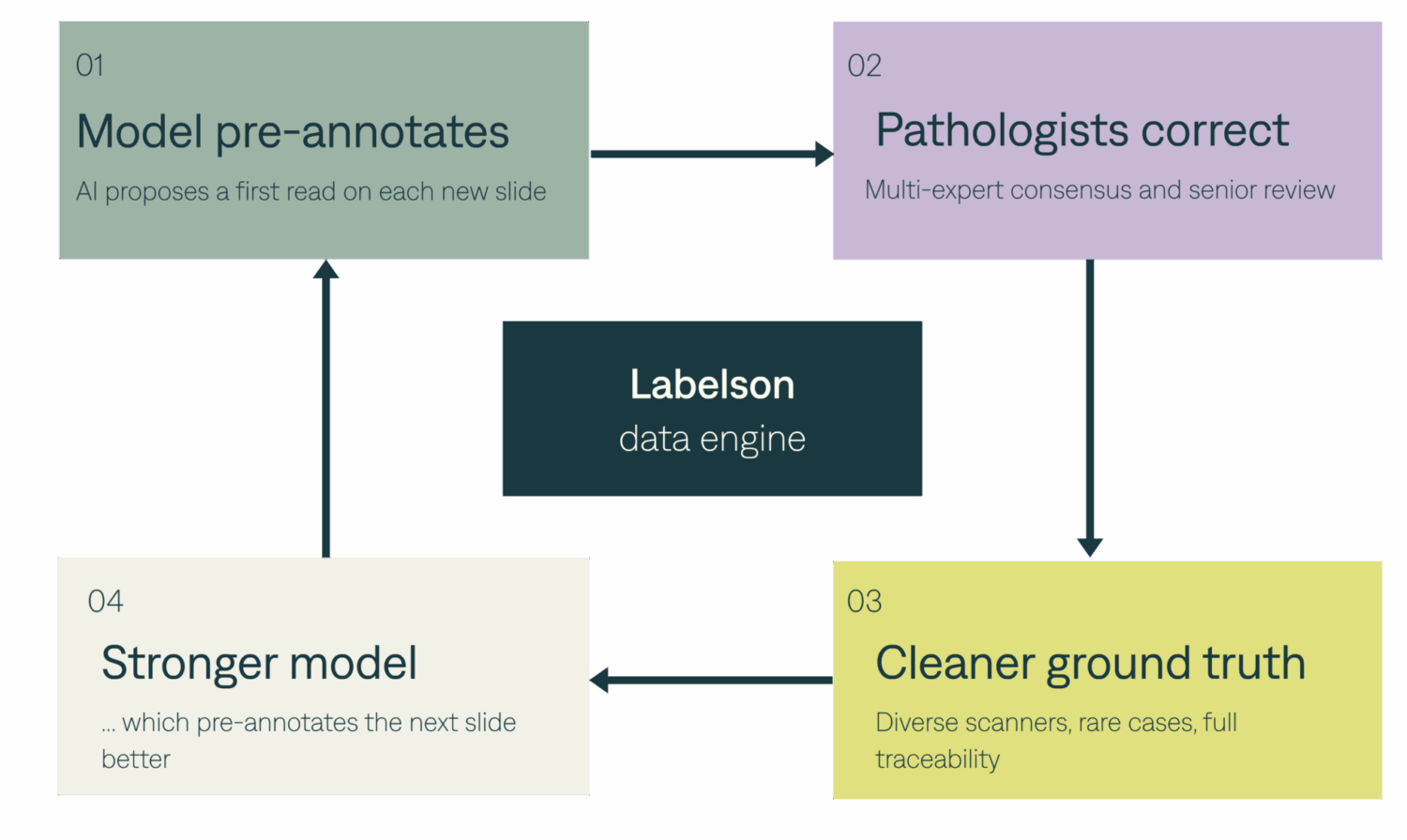
Our models don’t only consume data; they help produce it. A current model pre-annotates a new slide: it proposes a first read. The expert doesn’t start from a blank slate; they validate, correct, and refine. Those human corrections flow back and improve the next version of the model, which then pre-annotates the following slides a little better, so the expert corrects a little less, and so on.
Clean data leads to a stronger model. A stronger model produces data faster and better. And that data makes the next model stronger still. This loop, a data flywheel, has a property that’s easy to say and hard to copy: every case we process lowers the cost of the next one. A competitor can match our model architecture in a weekend; they cannot buy the accumulated turns of this loop, because that asset only exists as a function of time and iterations.
3. Real hospitals don’t look like clean benchmarks
A model that shines on one dataset can quietly fall apart in the clinic, and the usual culprit is domain shift: slides from a different scanner, a different lab’s staining protocol, a different patient population look statistically different from what the model saw in training. The pixels move; performance drops.
You don’t fix that at the model layer alone; you fix it at the data layer, by making sure the training data spans that diversity in the first place. Labelson is built to ingest slides from most of the scanner manufacturers on the market, in their heterogeneous formats, at scale. It’s why a model trained at Primaa keeps working under the messy, varied conditions of real pathology practice, not only in the lab. And since this is health data, patient privacy is built in from the start: data is anonymized in line with GDPR before any use. Confidentiality here is a foundation, not a layer added at the end.
4. Medicine lives in the long tail
Common findings are, by definition, common: a model picks them up quickly. The hard part is the long tail: rare subtypes, ambiguous morphologies, the unusual case a pathologist sees a handful of times a year. These are underrepresented in any dataset you collect passively, and they’re precisely where errors are most costly.
Owning our data pipeline means we don’t have to accept whatever distribution shows up. We can deliberately seek out and enrich the difficult, rare, and borderline cases, and direct expert effort where it moves the needle most. You can’t do that when you’re buying annotations by the batch from a vendor who has no idea which slides are the interesting ones.
5. Traceability isn’t bureaucracy, it’s part of the science
Building a medical device also means being able to prove how it was made. Labelson keeps end-to-end traceability: which data was annotated by whom, reviewed by whom, and folded into which version of which dataset. That means a result is reproducible and a dataset is auditable, the same standard we’d expect of any experiment.
This supports our regulatory certification and evaluation work, and it also happens to be good engineering hygiene. It’s the difference between « the model works, trust us » and « here is exactly what it learned from, and how we know. »
The unglamorous part that wins
Model architectures are shared, published, and reproduced quickly. A data-production capability is not. It depends on a network of qualified pathologists, on quality-control processes built and refined over time, and on the accumulated corrections of every case already processed. That combination is cumulative and specific to each organization, which is what makes it difficult to copy.
The practical consequence is simple. The quality of a Primaa model is, first and foremost, the quality of the data behind it. That is where we have chosen to invest, and Labelson is where that work happens.