



POSTER ECDP 2026
Joint Patch Segmentation and Whole Slide Classification in a Unified End to End Framework
By Fabian Sinzinger¹, Youssef Karout¹, Josselin Manceau¹, Marie Arrivat¹², Rémy Peyret¹
(1 Primaa, Paris, 2 LTCI, Télécom Paris, Institut Polytechnique de Paris)
Context
Problem: Multi-stage pathology pipelines often optimize patch segmentation and slide classification separately. Segmentation models see local information, while classifiers rely on coarse slide-level context.
Proposed: We combine both tasks in a differentiable framework. Patch segmentation outputs are aggregated into a slide-level heatmap, allowing classification loss to propagate back into the segmentation model.
Method
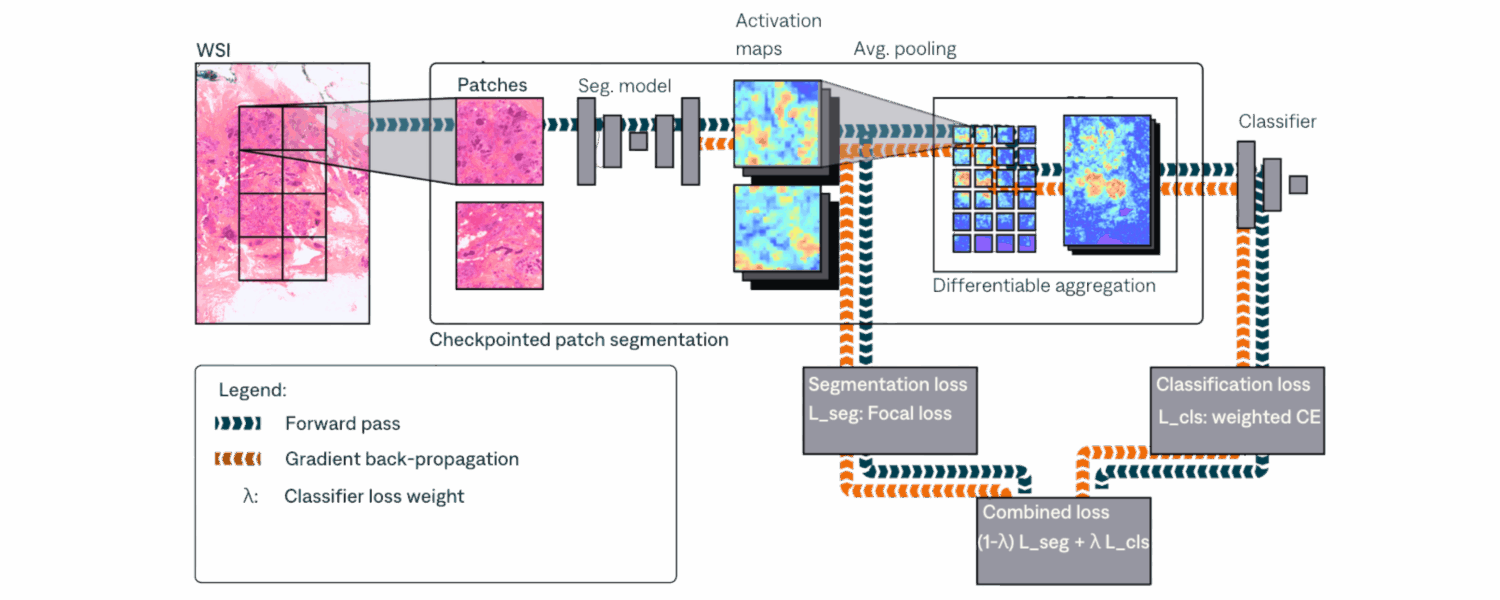
Fig. 1: Overview of the proposed training pipeline.
- Inner loop: patch mini-batches are processed by the segmentation model.
- Patch outputs are accumulated and down-sampled into a slide-level map.
- Binary Classifier predicts carcinoma status from the aggregated representation.
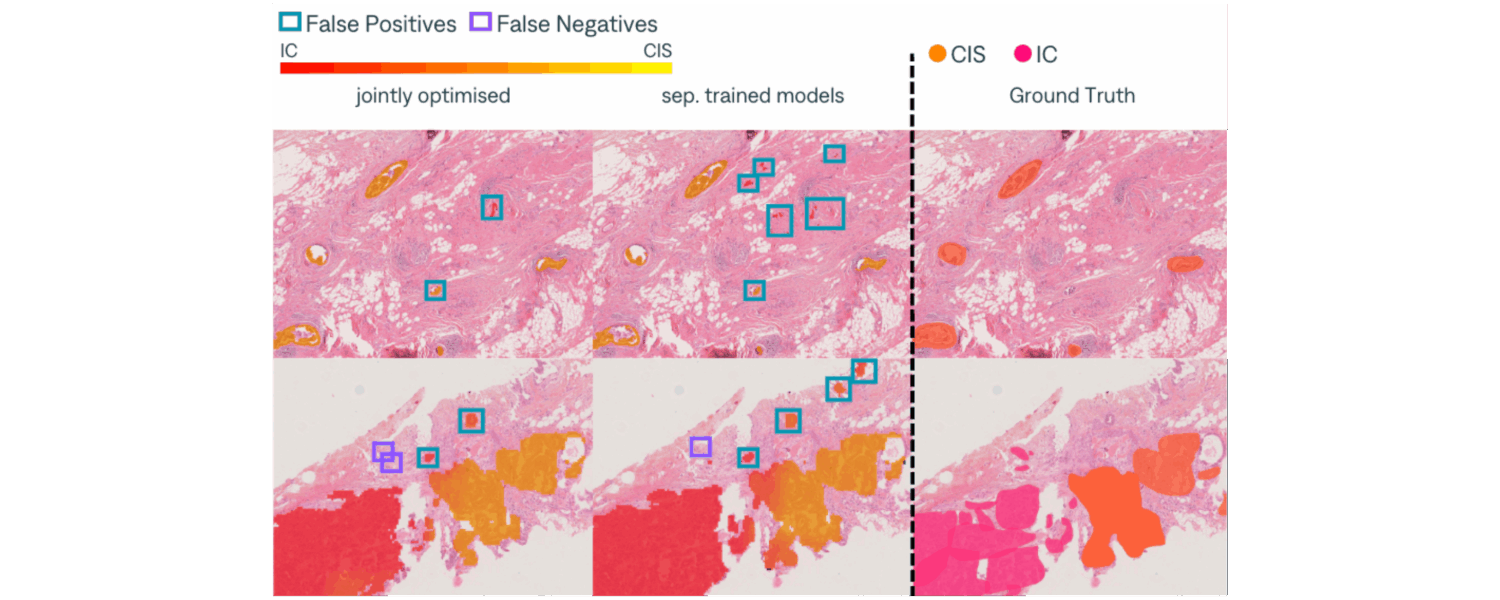
- Multi-class Segmentation predicts heat-maps of different carcinoma sub-types (Invasive/in-situ)
- Segmentation and classification objectives can be trained separately or jointly.
- Checkpointing recomputes patch forwards during backpropagation.
Dataset
- Training: MST26 train, 3 centers n=392 (337 carc. / 55 healthy)
- Validation: MST26 val, 3 centers n=86 (72 carc. / 14 healthy)
- Testing: Held-out single-center set n=128 (64 carc. / 64 healthy)
Preliminary Results
A) Ablation: combined loss weight
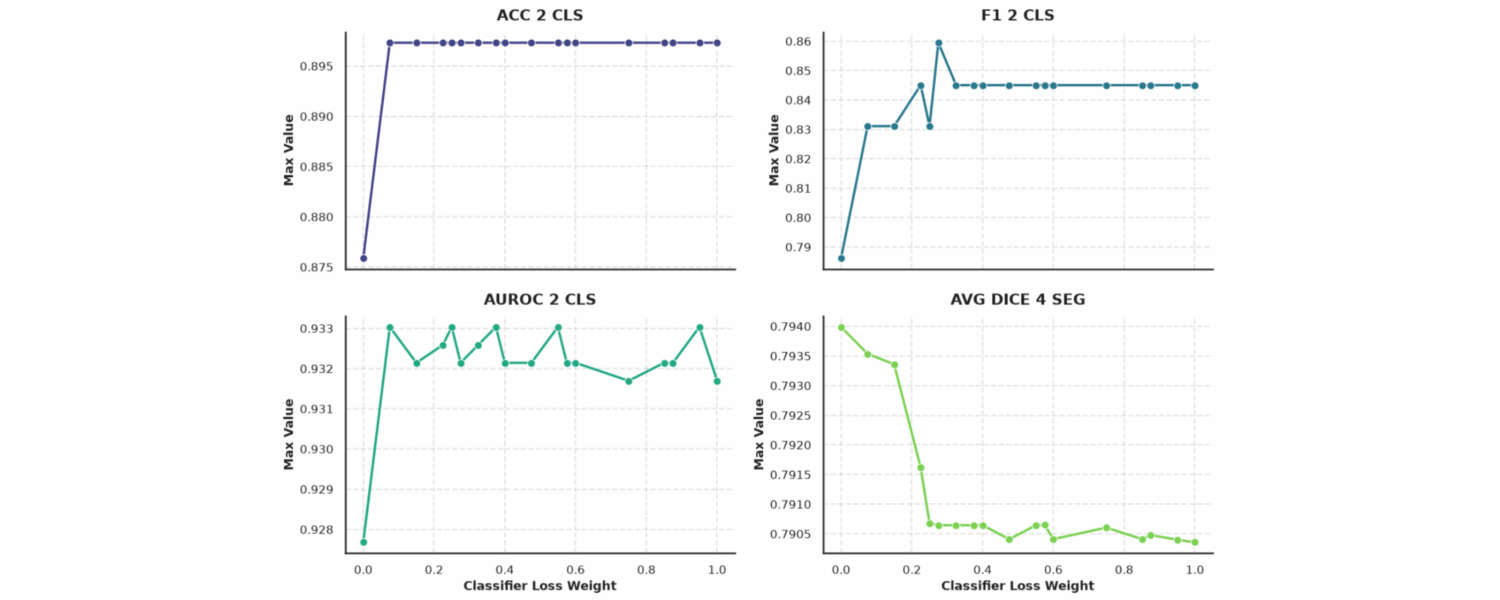
Fig. 2: fixed number (32) of finetuning epochs with varying classification loss weight.
B) Performance metrics
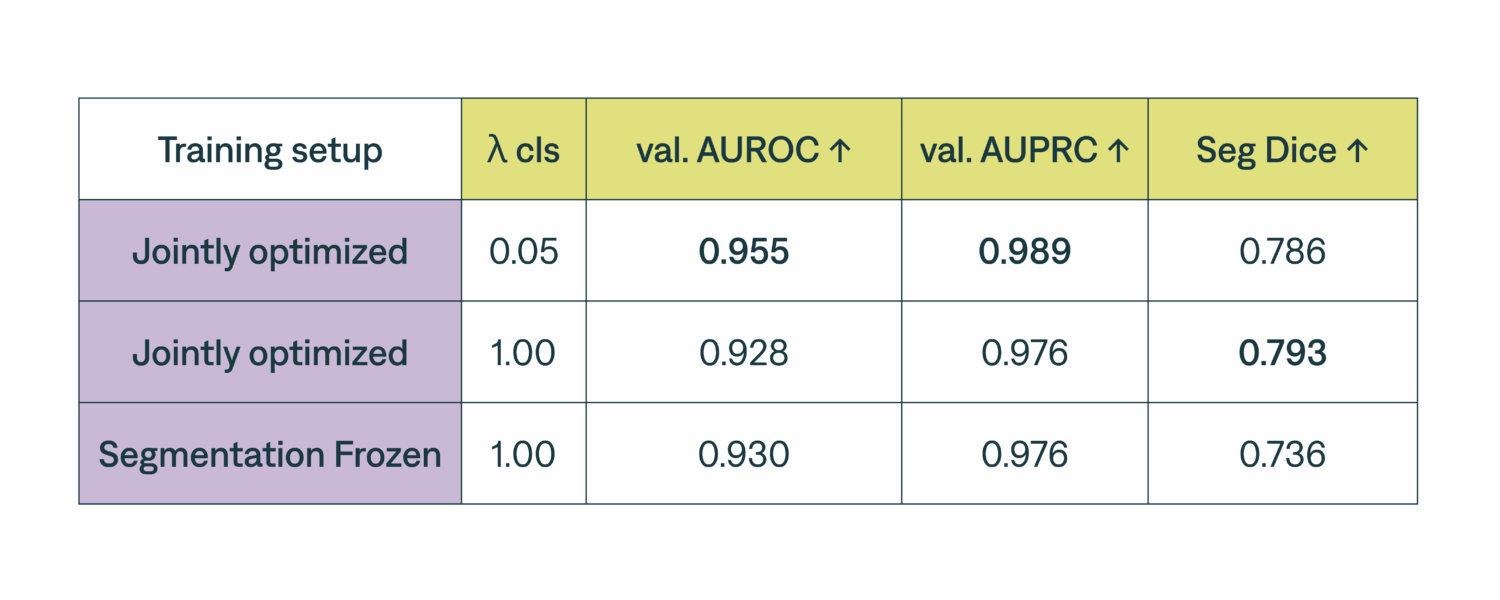
Tab. 1: Best validation checkpoints selected by AUROC after convergence.
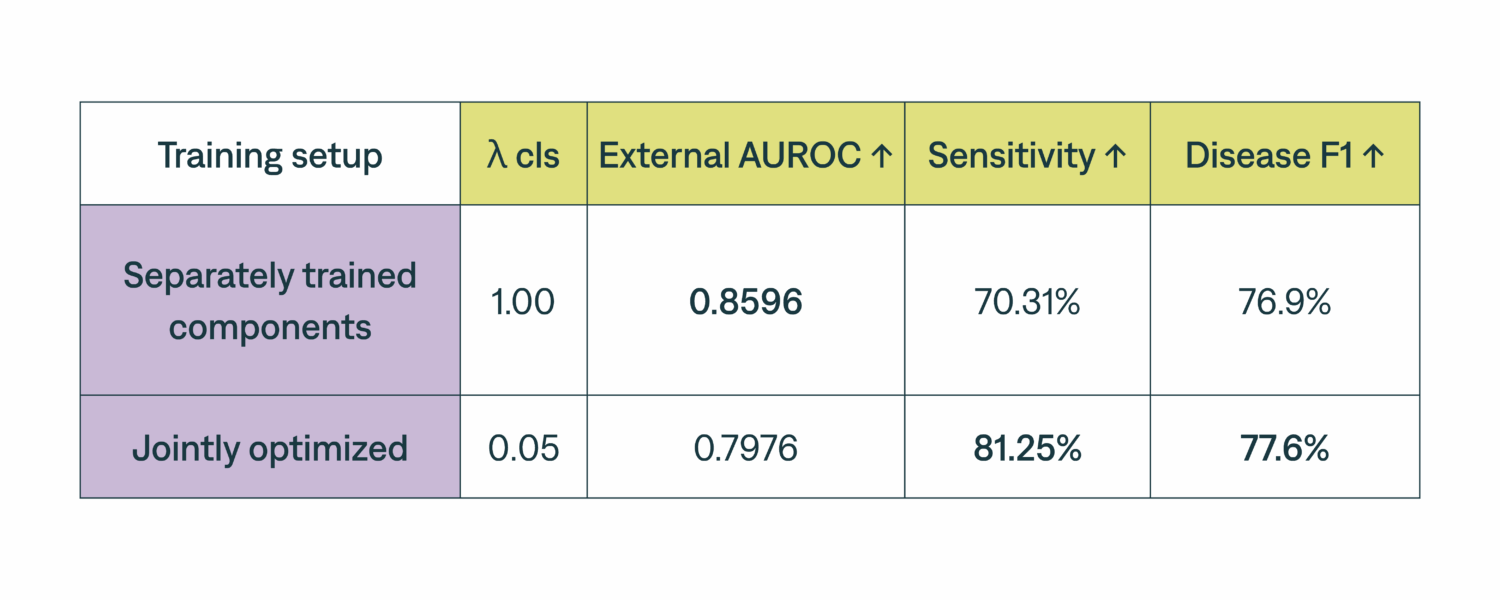
Tab. 2: External full-slide evaluation.
C) Qualitative demonstration: segmentation heatmaps
Conclusion
- We propose a differentiable online aggregation framework linking patch segmentation and whole-slide carcinoma classification.
- Joint training with low classification-loss weight improved online validation AUROC while largely preserving segmentation quality.
- External full-slide evaluation showed higher sensitivity but lower AUROC for joint models; training on patches from complete slides is expected to reduce this validation – test gap.
Limitations
- Classification performance is affected by class imbalance.
- Current aggregation does not explicitly model overlap between neighboring patches.
- Proof of concept models were trained on partially annotated slides.
REMARK: The original abstract demonstrated the framework on skin cancer data. In this poster, we apply the same methodology to a breast carcinoma cohort.
Future Work
- Train on larger public datasets and benchmark tasks from different histopathology problems.
- Compare against MIL and attention-based slide classifiers.
- Improve aggregation with overlap-aware or attention-based pooling.
- Train models from scratch within the same framework.
- Multi class classification